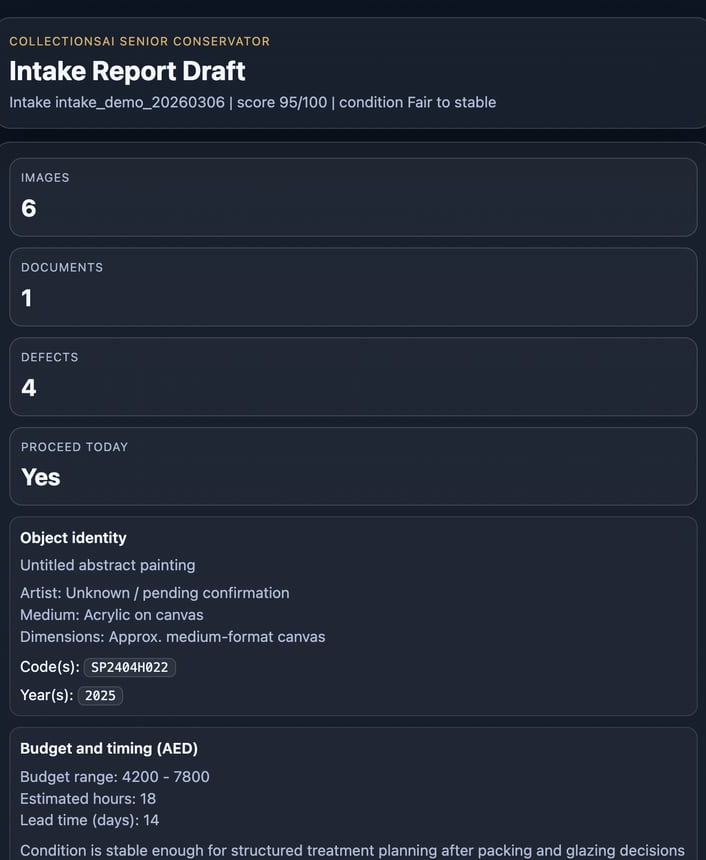
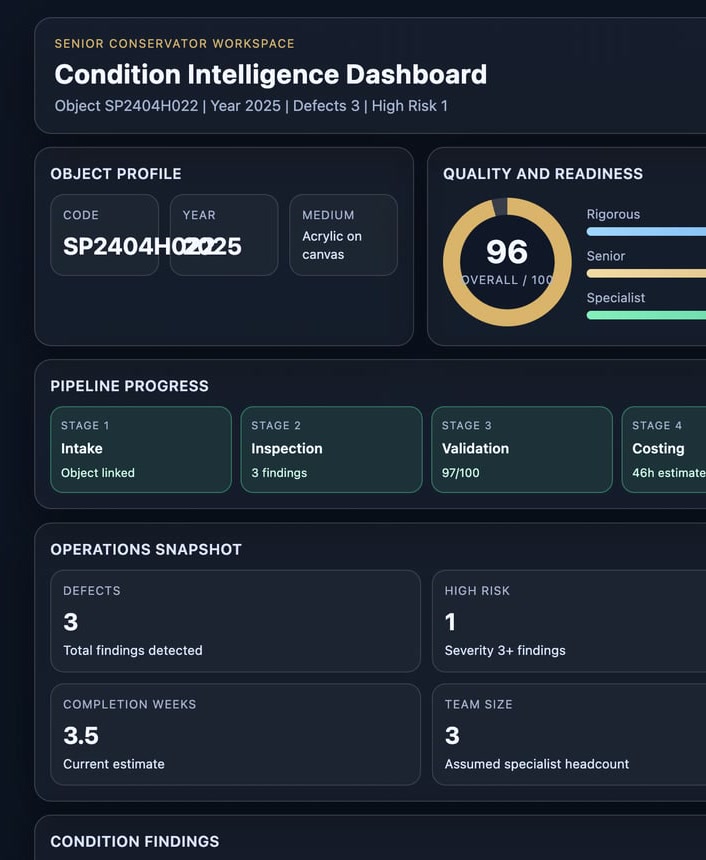
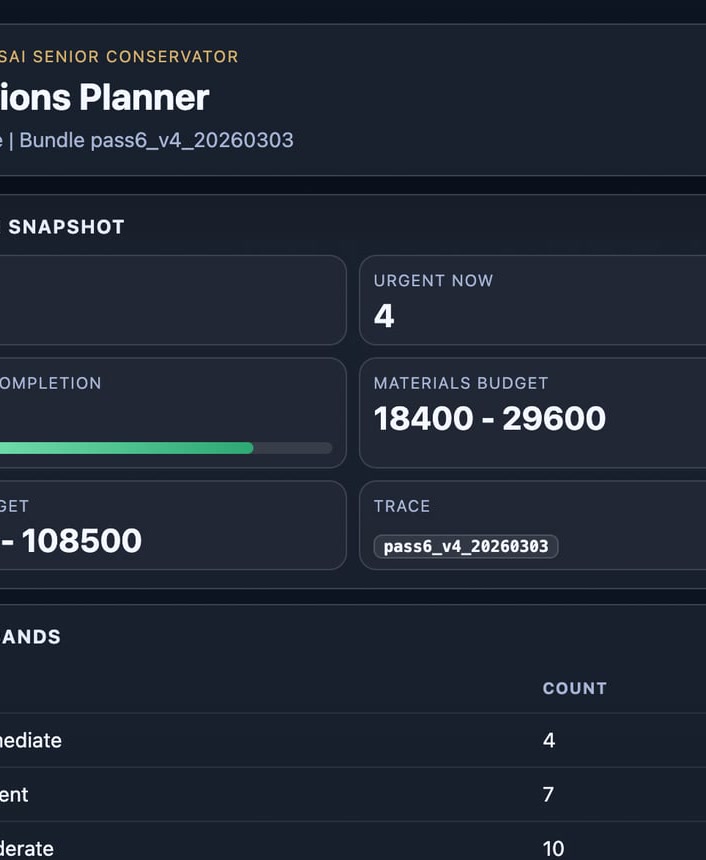
Strict release gate
Draft output is not the release event.
- Evidence is present before review starts
- Blocked issues stay visible until cleared
- A named human owner signs off before release
CollectionsAI ChatGPT Connector
CollectionsAI brings intake, strict review, and planning into ChatGPT without hiding the human approval step.
Built for the people who carry release responsibility: heads of collections, senior conservators, registrars, and operations leads.
Named pilot references remain private until permissions clear, so the public story has to earn trust with visible proof and explicit release controls.
Strict release gate
Inspection theatre
The landing page now includes one deliberate luxury moment: a dark inspection theatre that makes the release gate legible instead of hiding it inside tiny screenshots.
Move across the stage and the light follows the release gate. The effect is decorative, but the story is operational: the product is built around visible control.
Evidence trace
Photos, notes, and object context stay connected while the team reviews the case.
Blocked issue
Uncertainty is not polished away. The review screen keeps blockers visible until they are cleared.
Release owner
The last state change belongs to a named reviewer, not to a generic assistant response.
CollectionsAI
Authoritative decision-grade QA for complex collections.
Case under review
Hellenistic sculpture, linked notes, and evidence bundle loaded into the review state.
AI confidence
96%Evidence trace
A+Critical blocker
Storage report does not fully match the latest object notes, so release stays blocked.
Procedural blocker
Material-cost precedent must be confirmed before planning can be treated as release-safe.
Evidence and audit trace
Linked condition report, source photos, acquisition log, climate note, and human review note remain attached.
Human sign-off framing
Pending human decision. The release state does not change until a named reviewer clears the blockers.
Trusted by
Until named references can be published, the trust story has to stay honest: role fit, policy clarity, visible control, and one public product path.
Need faster case movement without letting release ownership disappear into a generic AI reply.
Need evidence-linked drafts, visible blockers, and a human release owner before anything leaves the workflow.
Need one place to connect intake, report questions, planning, and release-safe outputs.
Need planning answers that stay tied to the case evidence instead of breaking into separate spreadsheets and chats.
Policy and handling
Public pages expose product and policy information only. Protected artifacts remain outside the public surface.
Availability
Visitors can inspect the ChatGPT app page, the live demo, and the public policy surface without entering a gated sales funnel.
Rollout model
Institutions that need rollout review use the support path instead of a second competing CTA funnel on the landing page.
Why teams choose it
The strongest difference is structural: evidence-first intake, visible uncertainty, human release control, and operational follow-through in one workspace.
01
Uncertainty, blockers, and ownership stay on screen until a human reviewer clears the case.
02
Photos, notes, and object context remain attached as the case moves from intake to review and planning.
03
The same ChatGPT surface handles intake, review, staffing questions, and delivery preparation.
Strict review gate
A case only moves when the evidence is present, blockers remain visible, quality is high enough, and a named human owner clears release.
Gate 01
Bring the photos, notes, and object context into the thread before the case earns decision-grade confidence.
Gate 02
Missing context, unresolved risk, and low-confidence findings remain explicit instead of getting buried in polished output.
Gate 03
The case must clear the current quality threshold and produce a traceable rationale, not only a fluent answer.
Gate 04
CollectionsAI supports the decision, but the release state does not change without a named reviewer.
Workflow
The page stays short because the model is simple: gather evidence, review against the gate, then turn cleared cases into real work.
01
Bring photos, notes, report bundles, and object context into ChatGPT so the case starts from the real evidence set.
02
Surface findings, open questions, and release blockers before any output can read as final.
03
Use the same workspace to answer planning, staffing, and owner-facing delivery questions without breaking case context.
Comparison
Generic copilots can be helpful. This connector is built for the stricter moment when a team has to defend the release decision, not only generate a draft.
Starts from a prompt and hopes the right case context is already in the thread.
Starts from the evidence set, notes, and case structure before the decision workflow begins.
Can sound finished even when missing evidence or unresolved risk remain.
Keeps blockers, confidence, and evidence trace visible so uncertainty stays actionable.
Usually leaves approval and release state outside the workflow.
Requires a visible review gate and a human release owner before output is treated as release-ready.
Often stops at summarization and pushes planning into separate documents or spreadsheets.
Continues into staffing, materials, delivery, and artifact routing without breaking case context.
Feedback shaping the rollout
These are the questions that changed the page. They are not synthetic testimonials. They are the trust checks the public story has to answer clearly.
Reviewer question
Yes. The public ChatGPT app page is the primary CTA, and the live demo plus policy links are visible before any support conversation.
Reviewer question
The page now centers the review gate: blocked issues stay visible, quality has to clear, and a named human owner signs off.
Reviewer question
Named pilot references stay private until permissions clear, so the page uses dated validation, public links, and role-fit clarity instead of invented endorsements.
Reviewer question
The landing page now points to the main ChatGPT app path because that is the public product path under publication. Earlier Telegram surfaces stay out of the public CTA flow.
FAQ
No. The connector supports decision-making, drafting, and planning. Final treatment or release decisions still belong to a qualified human reviewer.
As of March 7, 2026, the public surface includes the ChatGPT app page, the live demo, support, privacy, and terms. The landing page also reflects the current connected-tool and burst-check posture already validated in the live app work.
Named pilot references are not shown publicly until permissions are cleared. This page uses dated verification and role-based fit instead of invented endorsements.
One sample report bundle or photo set, one operator or review owner, and a clear release workflow. The goal is to prove intake, QA, and planning fit before broader rollout.
Public pages stay separate from protected artifacts. Operators should share only the evidence required for the active conservation task, and client-facing outputs avoid unnecessary path exposure.
The current public path centers the ChatGPT workflow itself. Collection-management and system-of-record integration are evaluated during support-led rollout reviews so the workflow can be mapped to the institution's real handoff points instead of being promised generically on the public page.
The public ChatGPT app page is the main path. Institutions that need rollout review or scoped onboarding use the support path, keeping the landing page focused on one live product route.
One public path
The public app page is the main path. Support is the only secondary route, which keeps the landing story clear while still leaving room for scoped rollout conversations.
Public app
Open the ChatGPT app page to inspect the live public surface first.
Support
Use support when your institution needs a scoped rollout or release-workflow review.
Policies
Support, privacy, and terms remain visible from the landing page and the public app surface.